Basic llama care and herd management: housing, fencing and preventive health
Practical guide to responsible llama keeping on farms and smallholdings: mandatory herd companionship, safe fencing, shelter, heat-stress prevention, toenail trimming and herd health.
TodoLlamas · Editorial approach
Published · Content rewritten
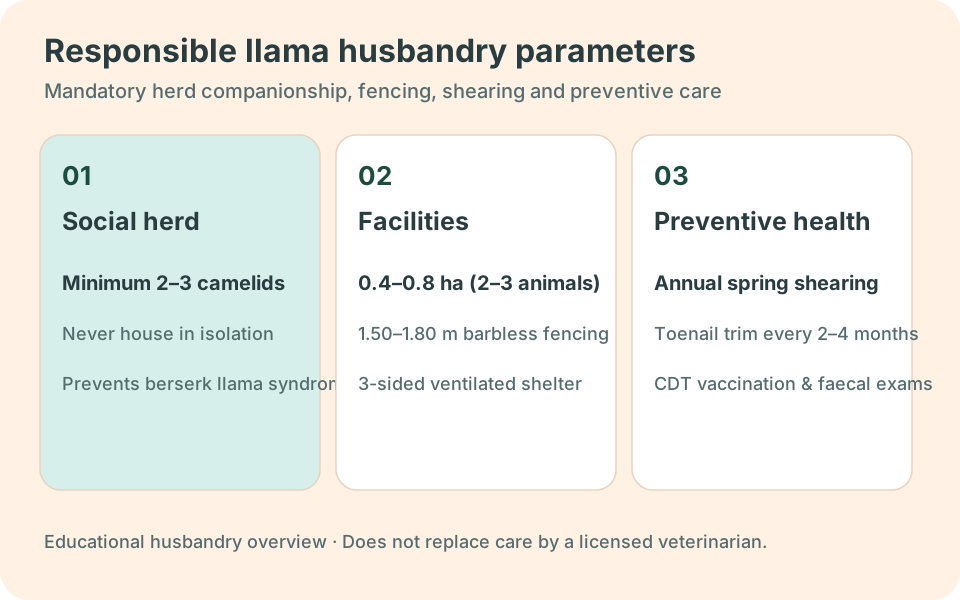
Responsible care for llamas (Lama glama) on a farm, smallholding or educational centre starts with recognising that they are not indoor pets, but large gregarious herbivores adapted to open mountain pastures. Their welfare rests on five pillars documented in veterinary manuals: mandatory companionship with other camelids, well-drained pastures with predator-safe fencing, ventilated shelters that prevent summer heat stress, a forage-first diet, and a preventive routine of shearing, toenail trimming and veterinary herd health monitoring. [1, 2]
Core welfare rule: never keep a llama alone
Both the Merck Veterinary Manual and the University of Michigan's zoological accounts emphasise that llamas are strictly social herd animals that suffer chronic stress when kept in isolation from conspecifics. A solitary llama exhibits persistent distress humming, reduced appetite, lethargy or abnormal behaviours directed toward humans or other livestock. [1, 5]
- Minimum group size: Every holding must keep at least two or three compatible camelids together (for example, two females or two gelded males).
- Sex and age grouping: Intact adult males erupt sharp caniniform "fighting teeth" at 2 to 3 years of age and compete aggressively over females. Intact breeding males should therefore be pastured separately from pregnant females, crias and juveniles. [1, 2]
- Balanced socialisation: Calm halter training supports low-stress veterinary care, while avoiding excessive humanisation of nursing crias prevents aberrant behaviour syndrome. [1]
Pasture space, safe fencing and shelter design
Although llamas respect fences better than goats or horses, they require adequate acreage to exercise, graze and maintain clean separation between feeding areas and communal dung piles: [1, 3]
| Management area | Technical recommendation | Welfare and safety rationale |
|---|---|---|
| Stocking density | 2 to 4 llamas per acre (~5 to 10 per hectare) depending on rainfall and pasture yield. | Prevents overgrazing, enables rotational grazing and lowers gastrointestinal parasite exposure. [1, 3] |
| Perimeter fencing | Barbless woven-wire livestock mesh 1.35 to 1.50 m (4.5–5 ft) high, flush with the ground. | Keeps out roaming dogs and wild canids and prevents llamas from entangling necks or fleece in barbed wire. [1] |
| Shelter & airflow | Three-sided run-in shed open away from prevailing winter winds (~3–4 m² shade per animal). | Shields against freezing winter rain while ensuring cross-ventilation during warm weather. [1] |
| Feeders & waterers | Raised hay racks with multiple feeding stations; continuous clean water supply. | Prevents fecal contamination of hay and stops dominant llamas from blocking subordinate herd mates. [3] |
| Restraint chute | Padded narrow handling chute (~45–55 cm wide) for calm examinations. | Allows vaccinations, Body Condition Scoring and toenail trimming without physical struggle. [1] |
Preventing heat stress in temperate and warm climates
Because llamas evolved in the cool, dry Andean highlands, they are far more vulnerable to hyperthermia (heat stress) than to winter cold. When ambient temperatures exceed 26–28 °C (80 °F) alongside high humidity, thick fleece traps metabolic heat and rectal temperature can climb dangerously above 39.5–40 °C, causing lethargy, open-mouth panting, drooling, scrotal oedema and male infertility, or fatal heatstroke. [1, 2]
Four preventive practices are essential outside high-Andean environments:
- Annual spring shearing: Shear the barrel and neck before warm weather arrives, leaving 1 to 2 cm of fibre along the dorsal spine to protect the skin against sunburn.
- High, breezy shade: Provide tall open-sided shade structures or mature trees with unrestricted airflow; enclosed barns trap heat and humidity.
- Ventral thermal-window cooling: Offer cool damp sand, shaded soil or shallow wading pools where llamas can lie in kush or wet their sparsely haired belly, groin and inner thighs (never hose water over the top of a thick unshorn fleece on a humid day, as warm water trapped in wool steams the skin). [1]
- Early-morning handling: Schedule any transport, hoof care or trekking strictly during the coolest morning hours.
Footpad and toenail care, dental checks and parasite control
Instead of a rigid equine hoof, the llama foot has two digits with soft plantar elastomer pads and curved toenails at the tips. On soft meadow soils without rocky abrasion, toenails grow faster than they wear down and can curl sideways, distorting toe alignment. Feet should be inspected every 2 to 4 months and trimmed flush with the sole pad using sharp hoof shears. [1, 2]
For herd health, work with a local veterinarian to maintain core vaccinations against clostridial diseases (such as Clostridium perfringens types C and D and tetanus, Clostridium tetani), perform targeted fecal egg counts before deworming, clear communal dung piles regularly, and palpate Body Condition Score (BCS 1–5) twice a year, as explained in our feeding guide and communication guide. [1, 2, 3, 4]
Frequently asked questions about basic llama care
How long do llamas live under good care?
The average lifespan of a well-managed domestic llama is 15 to 20 years, and individuals with sound dental care, nutrition and parasite management frequently live 22 to 25 years. [1, 5]
Why should barbed wire never be used for llama pastures?
Llamas have long necks, keen visual curiosity across fence lines and thin facial and inguinal skin; barbed wire causes severe lacerations to eyelids, ears and necks and snags fleece. [1]
Sources and references
- Merck Veterinary Manual: Management of Llamas and Alpacas
- Merck Veterinary Manual: Herd Health of Llamas and Alpacas
- Penn State Extension: Llamas and Alpacas Nutrition and Feeding
- Robert J. Van Saun, Penn State Extension: Body Condition Scoring of Llamas and Alpacas
- University of Michigan, Animal Diversity Web: Lama glama