How llamas communicate: vocalisations, body language and why they spit
Ethology and communication signals of llamas: humming, alarm calls, orgling, ear and tail posture, sternal kush position and why spitting happens.
TodoLlamas · Editorial approach
Published · Content rewritten
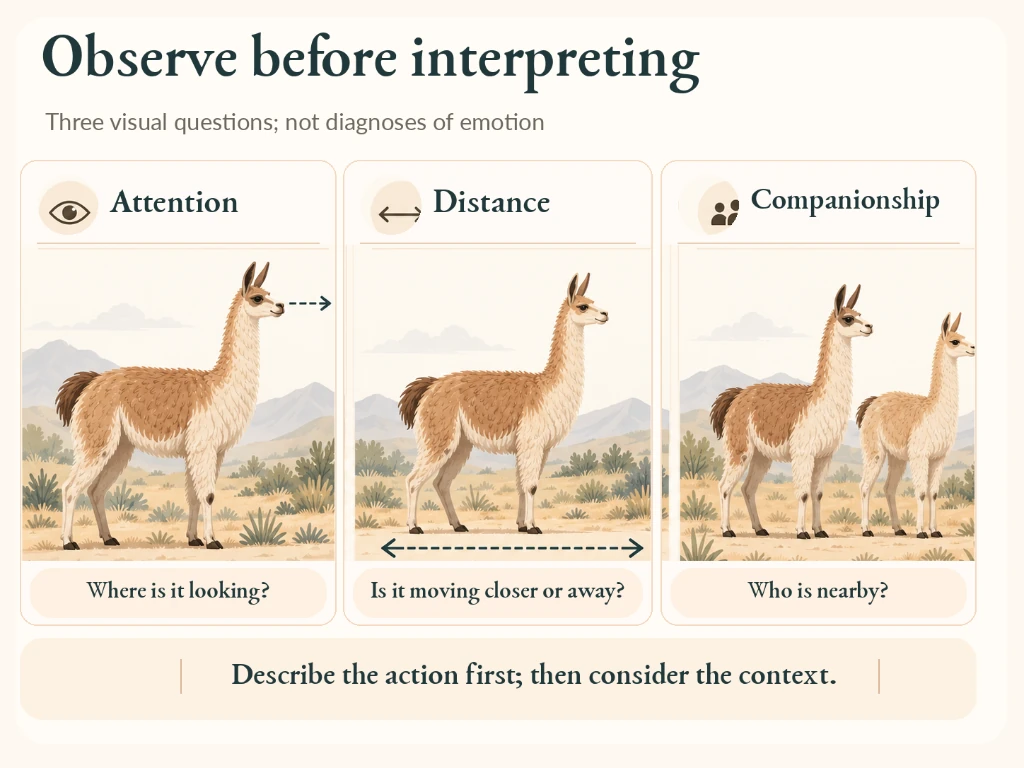
Llamas (Lama glama) communicate through a rich multimodal system combining modulated vocalisations, ear, neck and tail postures, tactile mother–young bonding, and olfactory signals at communal dung piles. As gregarious herbivores that evolved in open mountain landscapes, they rely on clear visual and acoustic signals to maintain herd cohesion, warn of predators and settle hierarchy disputes over feed or personal space without costly physical fights. [1, 2]
The vocal repertoire: humming, alarm calls and orgling
Zoological accounts (Animal Diversity Web) and veterinary manuals (Merck and MSD Veterinary Manual) document four primary vocalisation categories whose exact meaning depends on the social and environmental context: [1, 2, 3]
| Vocalisation | Acoustic profile | Typical herd context | What keepers should check |
|---|---|---|---|
| Humming | Soft, closed-mouth nasal tone that varies in pitch, rhythm and intensity. | Mother–cria contact, everyday herd cohesion, mild distress when separated, fatigue or early stage of labour. [1, 3] | If humming becomes high-pitched and persistent, check whether the animal is separated from companions, hungry or entering labour. |
| Alarm call | Sharp, rhythmic, high-volume whistling neigh orbray emitted by a vigilant herd member. | Visual detection of a potential predator (canids, pumas) or unfamiliar intruder near the pasture. [1] | The entire herd turns heads and ears toward the threat; inspect pasture perimeters immediately. |
| Orgling | Deep, rhythmic, guttural gurgling sound produced by the male during courtship and mating. | Exclusive to reproductive behaviour while the female lies in sternal recumbency (kush). [3] | Camelids are induced ovulators: prolonged copulation accompanied by orgling stimulates LH release and ovulation. [3] |
| Snort or throat cluck | Short burst of air or raspy throat sound accompanied by pinned ears. | Direct warning of personal-space intrusion or feeder competition immediately prior to spitting. [2] | Step back to restore distance; never corner the animal or grab its head forcefully. |
Body language: reading ears, neck, tail and the kush posture
Long before emitting a threat vocalisation or spitting, a llama broadcasts its comfort level through the angle of its banana-shaped ears, neck and tail. Reading the whole sequence—rather than a single frozen snapshot—prevents misunderstandings: [1, 2]
- Calm attention and curiosity: Ears upright and angled gently forward or swivelling toward a sound; neck vertical and relaxed; tail resting naturally flat against the rump.
- Deference or subordinate greeting: Younger or subordinate herd members may lower their head and neck slightly or curve the tail forward when passing a dominant adult near feed troughs.
- Tension, fear or defensive warning: The ears pin flat horizontally against the neck, the chin and nose tilt upward, and the tail arches or lifts tensely. This posture signals that the llama feels crowded or is preparing to defend its space. [2]
- The kush position (sternal recumbency): The llama lies on its breastbone with all four legs folded neatly beneath the body and the neck held upright. This is the normal physiological posture for chewing cud, resting out of the wind, regulating body heat via ventral ground contact or mating receptivity. However, a llama lying in kush with its neck stretched flat on the ground, lethargic or isolated from the herd requires immediate veterinary assessment. [2, 3, 4]
Why llamas spit and what the spit actually contains
Popular culture often portrays llamas as spitting at people out of bad temper. In reality, spitting is a highly ordered intra-species social boundary mechanism that resolves conflicts within the herd without physical injury. Among llamas, spitting occurs in three specific situations: [2, 3]
- Feeder hierarchy: To move a herd mate away from a specific spot at the hay rack or mineral trough.
- Reproductive rejection ("spitting off"): When a female is already pregnant or has high progesterone levels from luteal activity, she forcefully spits at an approaching male and refuses to kush; breeders widely use "spitting off" as an initial behavioural indicator of pregnancy. [3]
- Self-defence when cornered or mishandled: Directed at humans only when a llama feels trapped, has its head restrained roughly or was improperly imprinted as a juvenile. [2, 4]
Keepers also distinguish two levels of spitting: a warning air-and-saliva spray from the mouth, and a full C1 forestomach regurgitation (greenish, acidic liquid brought up from the first stomach compartment for serious disputes), after which the llama often lets its lower jaw hang open briefly to air out the sour taste.
Herd life, communal dung piles and preventing abnormal imprinting
Llamas also communicate chemically through communal dung piles (latrines): designated areas of the pasture where all herd members queue to defecate and urinate. This behaviour marks group territory and naturally limits gastrointestinal parasite transmission by keeping grazing areas clean. [1, 2]
Finally, the Merck Veterinary Manual highlights a serious behavioural disorder known as berserk male syndrome (aberrant behaviour syndrome): it develops when a cria (especially a male) is bottle-fed with excessive human handling in isolation from other camelids. At sexual maturity, the animal treats humans as conspecific rivals or mates, losing normal personal-space inhibition and charging, rearing or biting with its sharp fighting teeth. Prevention requires raising crias within a camelid herd, as detailed in our baby llama guide and basic care guide. [2, 4]
Frequently asked questions about llama communication
What should I do if a llama pins its ears back and raises its chin?
Pause calmly, avoid staring directly into its eyes, step back to give it an open path to walk away, and do not attempt to touch its face or neck. Once comfortable distance is restored, its ears will return to a relaxed upright position. [2]
Can llamas act as livestock guardians for sheep or goats?
Yes. A single well-socialised adult llama (typically a gelded male or female) placed with a flock of sheep or goats bonds with the herd, emits sharp alarm calls when spotting solitary canid predators (such as foxes or coyotes) and postures defensively to protect the flock. [1, 2]