Differences between llama, alpaca, vicuña and guanaco: identification guide
Anatomical, genetic and ecological comparison of the four South American camelids: ears, height, weight, fibre, domestication and habitat.
TodoLlamas · Editorial approach
Published · Content rewritten
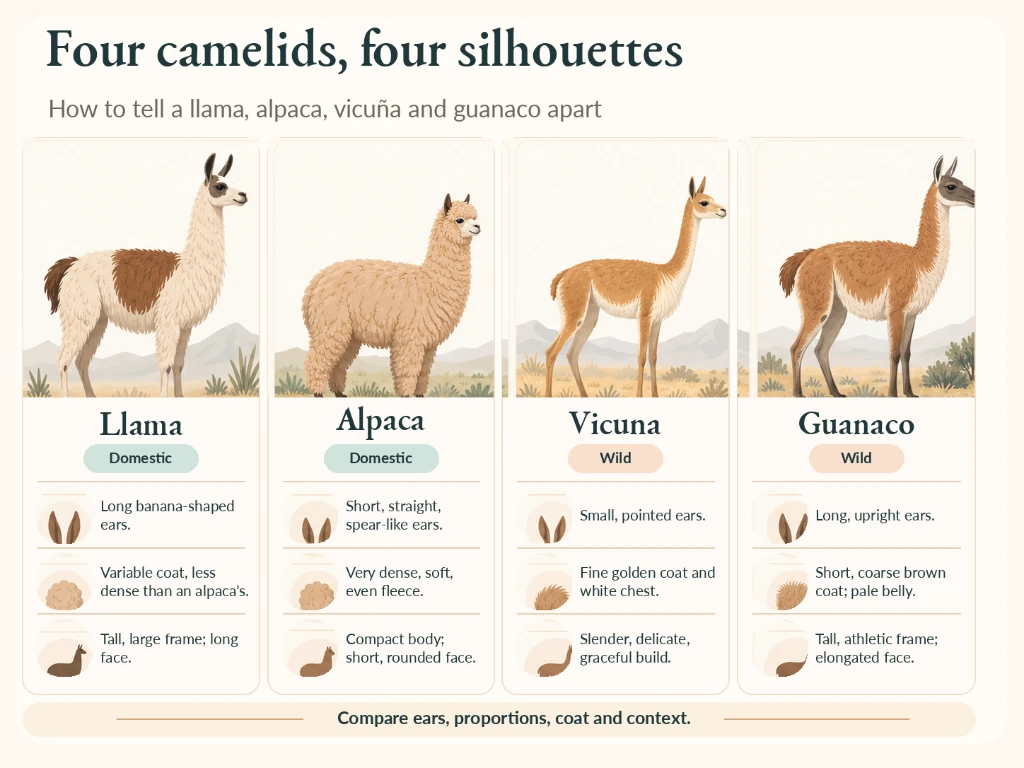
The four South American camelids form the tribe Lamini within the family Camelidae and comprise two domestic species—the llama (Lama glama) and the alpaca (Vicugna pacos)—and two wild species—the guanaco (Lama guanicoe) and the vicuña (Vicugna vicugna). Accurate field or photographic identification relies on combining five diagnostic features: ear shape, facial profile and forehead wool, dorsal and rump proportions, coat colouration pattern, and height at the withers. [1, 2, 3, 4, 5]
Comparative table of the four South American camelids
While recent shearing or juvenile age can alter an animal's apparent outline, cranial anatomy (ear and muzzle length), dorsal line and adult body mass clearly separate the four species: [1, 2, 3, 4, 5]
| Diagnostic feature | Llama (Lama glama) | Alpaca (Vicugna pacos) | Guanaco (Lama guanicoe) | Vicuña (Vicugna vicugna) |
|---|---|---|---|---|
| Status and origin | Domestic; domesticated from the guanaco. | Domestic; domesticated from the vicuña. | Wild; ancestor of the llama. | Wild; ancestor of the alpaca. |
| Adult body mass | 130 – 200 kg | 55 – 85 kg | 90 – 140 kg | 40 – 60 kg |
| Height at withers | 110 – 120 cm (up to 180 cm at head) | 85 – 95 cm | 100 – 115 cm | 75 – 85 cm |
| Ears and face | Long inwardly curved ("banana") ears; elongated clean face without forehead topknot. | Short, straight spear-shaped ears; shorter muzzle and dense woolly topknot on forehead. | Medium straight ears; characteristic dark grey to blackish face. | Slender alert ears; small head with pale face and prominent eyes. |
| Back, rump and tail | Level dorsal line; higher tail set, often held slightly away from body. | Compact build with rounded, sloping rump; tail held close to body. | Athletic, sturdy wild frame; long neck and muscular limbs. | Very slender, gracile build; long neck with white chest bib. |
| Coat and colouration | Over twenty solid and spotted colours (white, black, brown, piebald); Q'ara and Ch'aku types. | Over twenty natural uniform or spotted shades; Huacaya and Suri fleece types. | Uniform reddish-brown upper coat with white belly, chest and inner legs. | Pale cinnamon-fawn back, white underparts and long white chest apron. |
| Fibre diameter | 20–30 µm (dehaired undercoat); 35–60 µm (guard hair). | 18–28 µm (dense uniform fleece). | 16–18 µm (fine undercoat beneath guard hair). | 12–14 µm (among the finest mammal fibres in the world). |
How to tell a llama from an alpaca at a glance
Confusion occurs most often between the two domestic species because both display white, black, brown or multi-coloured coats and share pastures on farms. Three anatomical landmarks settle the identification even in close-up photographs: [4, 5]
- Ear curvature: A llama's ears are noticeably long and curve inward at the tips like a banana. An alpaca's ears are much shorter, triangular and point straight upward like small spears.
- Forehead and muzzle profile: Llamas have a longer skull covered in short smooth hair on the face, leaving the forehead and eyes clear. Alpacas have a blunter muzzle and typically grow a dense woolly topknot over the forehead and cheeks.
- Body frame and historical purpose: An adult llama weighs roughly twice as much as an alpaca, has a flat horizontal back and was bred for pack transport as well as fibre and meat. The alpaca has a smaller, rounder frame with a sloping rump and was selected specifically for dense fine fleece. [5]
Each domestic species also includes two distinct varieties documented by the FAO: among llamas, the short-coated Q’ara (classic pack conformation with minimal neck and leg wool) and the woolly Ch’aku (or T’amphulli); among alpacas, the Huacaya (crimped, spongy fleece growing perpendicular to the skin) and the Suri (long, lustrous lock-forming fibres that drape down the sides). [5]
Distinguishing the two wild camelids: guanaco vs. vicuña
Unlike domestic camelids, neither the guanaco nor the vicuña exhibits piebald spotting or solid black or white coats (save rare leucistic individuals). Both display counter-shaded wild camouflage—tawny backs and white underparts—yet they differ markedly in size, facial markings, dentition and habitat range: [2, 3]
- The guanaco (Lama guanicoe): Weighing 90 to 140 kg—more than twice a vicuña—the guanaco has a rich reddish-brown coat and a distinctive charcoal-grey to blackish face. It occupies the widest ecological range of any South American camelid, from sea-level Patagonian steppes and Tierra del Fuego up to over 4,000 metres in the Andes. [2]
- The vicuña (Vicugna vicugna): The smallest and most gracile camelid (40–60 kg), with a pale cinnamon coat and a prominent bib of long white hair hanging from the chest (longest in the southern subspecies V. v. vicugna and shorter in the northern V. v. mensalis). Its lower incisors have open roots and grow continuously, an adaptation to clipping tough short turf in the high puna above 3,700 metres. [3]
Genomics, domestication and hybridisation (2n = 74)
For decades, zoologists debated the exact evolutionary relationships among the four camelids. In 2020, whole-genome sequencing by Fan and colleagues in Genome Biology conclusively confirmed two independent domestication events in the Andes roughly 4,000 to 5,000 years ago: the llama was domesticated from the guanaco (Lama guanicoe) and the alpaca from the vicuña (Vicugna vicugna), supporting the classification of the alpaca in the genus Vicugna (Vicugna pacos). [1]
The same genomic study revealed substantial post-conquest genetic introgression between llamas and alpacas after the sixteenth-century collapse of indigenous breeding systems. Because all four South American camelids share the exact same karyotype (2n = 74 chromosomes), they can interbreed and produce fertile offspring: a cross between a male llama and a female alpaca is called a huarizo, the reciprocal cross a misti, and an alpaca–vicuña cross a paco-vicuña. [1, 5] To explore their fossil origins, read our guide to camelid evolution.
Frequently asked questions about the four camelids
Which of the four camelids produces the finest wool?
The wild vicuña produces the finest fibre (12 to 14 microns in diameter), harvested today through regulated live-capture communal shearings (chaccu). Between the two domestic species, alpacas produce finer overall fleece (18–28 µm) than unseparated llama coats, though dehaired llama undercoat (20–30 µm) is remarkably soft, as explained in our llama fibre guide. [3, 5]
Are alpacas gentler than llamas?
Both are social domestic species whose demeanour reflects handling and herd socialisation rather than a fixed species score. Because of their smaller size, alpacas are often shyer around individual handling, whereas well-trained llamas are calm and steady on a halter. See our llama communication guide for details. [4, 5]
Sources and references
- Fan et al. (2020): Genomic analysis of the domestication and post-Spanish conquest evolution of the llama and alpaca
- University of Michigan, Animal Diversity Web: Lama guanicoe
- University of Michigan, Animal Diversity Web: Vicugna vicugna
- University of Michigan, Animal Diversity Web: Lama glama
- FAO: Alpaca and llama husbandry manual (Spanish), introduction and distribution