Llamas, bofedales wetlands and sustainable high-Andean pastoral ecology
Ecological analysis of camelid pastoralism in the Andes: bofedales peat wetlands, padded foot anatomy, grazing mechanics and rotational herd management.
TodoLlamas · Editorial approach
Published · Content rewritten
Across the high-mountain ecosystems of the central Andes—between 3,700 and 5,000 metres above sea level—raising llamas (Lama glama) and alpacas (Vicugna pacos) forms a socio-ecological system shaped by more than four thousand years of co-evolution among puna grasslands, high-altitude peat wetlands (bofedales) and indigenous herding communities. Understanding how llamas relate to environmental sustainability requires examining both their low-impact anatomical adaptations to fragile mountain soils and the stocking density and water-management practices that govern real ecosystem health. [1, 2, 3]
Grazing anatomy: how padded feet and camelid dentition protect mountain soils
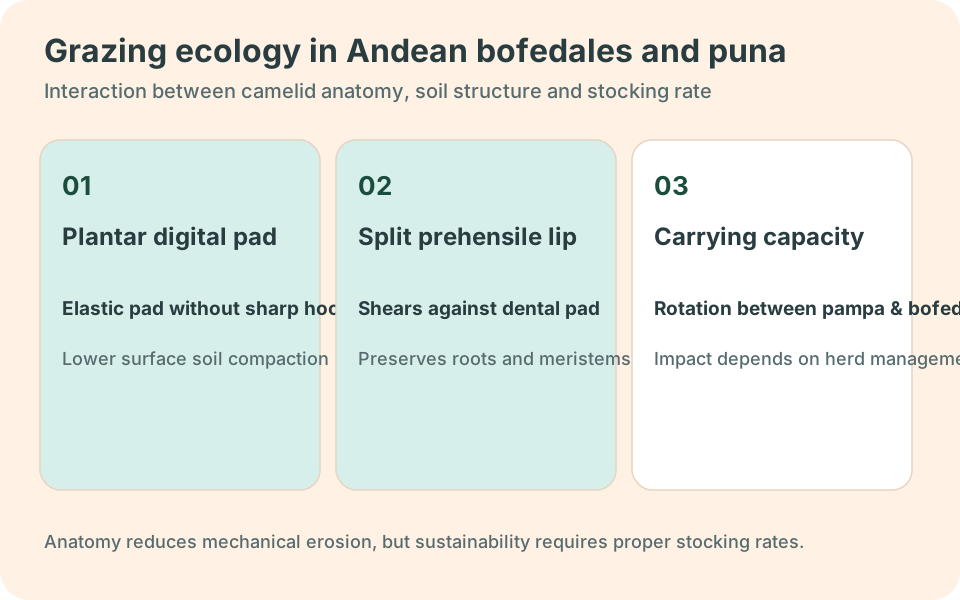
FAO technical manuals and zoological research highlight three fundamental biomechanical and digestive differences between native South American camelids and the hooved livestock introduced to the Andes from the sixteenth century onward (sheep, cattle, goats and horses): [1, 4, 5]
| Functional trait | South American camelids (Llama & Alpaca) | Introduced ungulates (Sheep, Cattle, Horses) | Ecological effect on fragile puna soils |
|---|---|---|---|
| Foot structure & tread | Two digits with soft elastic plantar pads (suborder Tylopoda) and short front toenails. [4] | Rigid keratin hooves with sharp edges (unguligrade artiodactyls and perissodactyls). | Soft pads distribute weight across wet turf without slicing sod or severely compacting peat wetlands. |
| Forage prehension & cutting | Mobile split upper lip grasps stems while lower incisors clip grass cleanly against the upper dental pad. [5] | Cattle wrap and pull grass with the tongue; sheep and goats graze down to root crowns; horses bite with upper and lower incisors. | Clean stem clipping without upward pulling leaves root systems and basal meristems intact for post-grazing regrowth. |
| Fibrous forage efficiency | Three-compartment stomach with slow fibre retention and high salivary urea recycling. [5] | Lower relative digestive efficiency on lignified dry highland tussock grasses (ichu). | Llamas utilise dry hillside tussock grasses effectively rather than concentrating solely on tender valley bottoms. [1] |
Crucially, however, anatomical adaptation does not guarantee automatic "zero impact": if stocking rates exceed pasture carrying capacity or seasonal rotation breaks down, camelid herds can also overgraze highland vegetation. [1, 2]
The ecological role of bofedales (high-Andean peat wetlands)
Across the arid and semi-arid puna of Peru, Bolivia, northern Chile and northwestern Argentina, pastoral life revolves around bofedales (known as oqhos in Quechua or juqhus in Aymara). These high-altitude wetlands are built by densely packed cushion plants (such as Oxychloe andina and Distichia muscoides) that accumulate organic matter in cold, water-saturated basins, creating deep alpine peatlands. [2, 3]
Bofedales perform three vital environmental functions across the cordillera:
- Watershed regulation: Acting as natural mountain sponges, they absorb glacial meltwater and summer rains and release water steadily throughout the eight-month dry season into streams supplying both highland villages and coastal valleys.
- High-altitude carbon storage: Cold waterlogged soils slow microbial decomposition, allowing bofedal peat layers to store dense stocks of organic carbon.
- Dry-season forage reserve: As documented in the 2025 FAO field story on Aymara herder Conrado Blanco Mamani in Guallatire (northern Chile, at 4,500 metres), bofedales supply essential green forage and water when surrounding hillsides dry out completely. [3]
Traditional ecological knowledge: rotational grazing and water channels
Far from being purely untouched wilderness, many Andean bofedales have been expanded and sustained for centuries by pastoral communities through hydraulic and grazing techniques documented by the FAO Pastoralist Knowledge Hub: [2, 3]
- Infiltration and diversion channels: Herders maintain small stone-and-earth channels that spread spring water laterally across wetland margins, preventing stream incision and keeping peat cushions hydrated.
- Seasonal rotational grazing (moya or ayanaqa): During the austral summer rainy season, llama herds move up to rocky slopes and dry tussock grasslands so lower wetlands can rest and set seed; during the dry season, bofedal grazing is carefully rationed.
- Complementary mixed herds: While alpacas prefer succulent cushion plants in moist bottomlands, larger llamas readily browse dry hillside Festuca and Stipa grasses and tola shrubs, spreading grazing pressure across ecological belts. [1, 3]
- Nutrient cycling (taquia): Communal dung piles concentrate organic matter and nitrogen in defined patches that stimulate localised grass recovery and provide natural fertiliser for high-altitude bitter potato and quinoa plots. [1, 4]
To explore the full geographic range of these pastoral systems, see our guide to where llamas live and review textile properties in our llama fibre guide.
Frequently asked questions about llamas and Andean ecology
What threatens the high-Andean bofedales where llamas graze today?
Tropical glacier retreat driven by climate change, longer spring droughts, groundwater extraction in arid basins, and rural depopulation that leaves traditional highland irrigation channels without communal maintenance. [2, 3]
Does the word "llama" on a label automatically prove a textile is sustainable?
Not by itself. Although llama fibre is biodegradable, durable and lanolin-free (requiring minimal water and no harsh solvents during scouring), a garment's overall environmental footprint depends on pasture stocking rates, shearing welfare, dye processes and transport. [1]
Sources and references
- FAO: Alpaca and llama husbandry manual (Spanish), introduction and distribution
- FAO: Pastoralist Knowledge Hub, Latin America
- FAO (2025): Conrado Blanco Mamani, herder in Guallatire, Chile (Spanish)
- University of Michigan, Animal Diversity Web: Lama glama
- Penn State Extension: Llamas and Alpacas Nutrition and Feeding