How to draw a llama step by step: proportions, grid and fleece texture
Learn how to draw a side-view llama in six steps using a 12 × 9 cm coordinate grid, anatomical proportion studies, fleece shading and a printable practice sheet.
TodoLlamas · Editorial approach
Published · Content rewritten
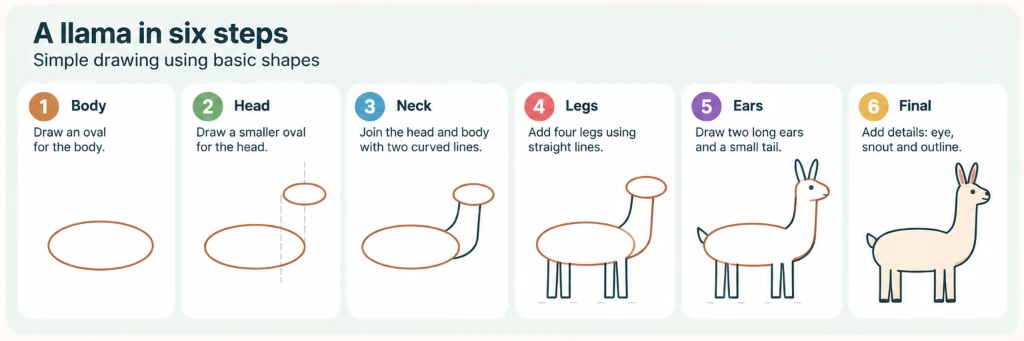
Drawing a convincing llama (Lama glama) requires balancing its slender skeletal frame against the visual bulk of its fleece coat. When beginners try to sketch the entire outer contour in one continuous line, they often make the neck too short or round off the back until the animal resembles a sheep or an alpaca. This tutorial solves that problem by breaking the side-view silhouette down into basic geometric shapes—two main ovals linked by a curved neck column and supported by four long legs—mapped onto a 12 × 9 cm coordinate grid. [1] The six panels on the reference sheet show a single drawing developing stage by stage from initial construction lines to the finished outline.
Setting up the 12 × 9 cm grid and drawing tools
Gather smooth or fine-tooth drawing paper, a medium-hard graphite pencil (2H or HB) for light construction lines, a kneaded or soft plastic eraser, and a softer pencil (2B or 4B) or fine-liner pen for the final contour. Download the A4 practice sheet or rule a 12 cm wide by 9 cm high rectangle in your sketchbook. Divide the horizontal axis (x) into four 3 cm columns (marks at 3, 6, 9 and 12 cm) and the vertical axis (y) into three 3 cm rows (marks at 3, 6 and 9 cm measured downward from the top edge). These twelve 3 × 3 cm squares provide a coordinate system that keeps every anatomical landmark in proportion.
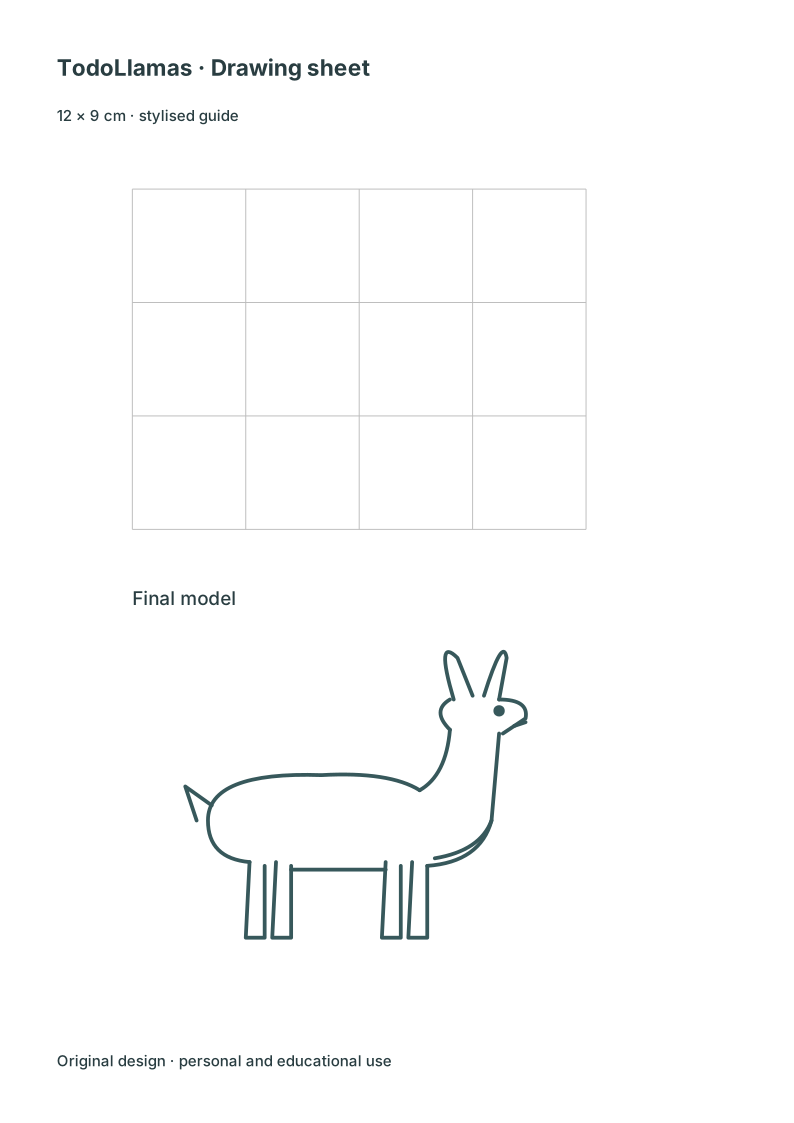
Six reproducible steps on the coordinate grid
- Torso oval (step 1). Using very light pressure with your HB pencil, sketch a horizontal oval extending from approximately x = 2 to x = 8 cm, between y = 4 and y = 6.5 cm. Keep the upper edge relatively flat to anticipate the llama's straight topline; much of this guide oval will be erased in step 6.
- Head oval (step 2). Place a smaller, slightly tilted oval in the upper right quadrant from x = 8.2 to x = 10.4 cm and y = 1.8 to y = 3 cm. Taper the right end slightly toward the muzzle, keeping the head clearly elevated above and forward of the chest.
- Neck column (step 3). Connect the back and underside of the head oval to the front of the torso oval with two smooth parallel curves. Never draw the neck as a single stick line: a llama's neck has substantial width from its cervical musculature and fleece, flowing seamlessly into the chest without a sharp corner.
- Legs and ground baseline (step 4). Draw two pairs of descending lines from the belly down to a shared ground baseline at y = 8.3 cm. Offset the farther front and hind legs slightly to the right to create three-dimensional depth, and finish each limb with a short horizontal foot resting squarely on the baseline.
- Curved ears and tail (step 5). Above the back of the head, add two tall upright ears whose tips curve gently inward—the classic “banana-shaped” ear profile of the llama. [1] At the rear of the body oval (around x = 2 cm), add a short downward-sloping tail tucked close to the rump.
- Clean-up and final contour (step 6). Erase the internal oval segments crossing the base of the neck and the upper legs. Place the large eye midway along the head, add the nostril and split lip line, and darken your final outline—using smooth lines along the muzzle and lower legs and slightly broken, textured strokes along the neck and torso to suggest the coat.
Anatomical proportion studies for freehand drawing
Once you are comfortable with the grid exercise, three anatomical ratios will help you sketch llamas freely in any posture: [1]
- The rule of vertical thirds: In an alert standing side view, total height from the ground to the poll divides almost equally into three vertical bands: the lower third spans from the ground to the sternum (the free length of the legs), the middle third represents the dorso-ventral depth of the ribcage, and the upper third encompasses the vertical rise of the neck and head.
- Straight topline and high croup: Unlike alpacas, whose hindquarters slope down in a rounded curve toward a low-set tail, llamas exhibit a level dorsal line from the withers across the loin to the pelvis, with the tail set high.
- Padded foot posture and joint angles: Camelids do not stand on vertical horn hooves like horses or cattle; instead, their second and third phalanges rest semi-horizontally on soft plantar digital pads tipped with small toenails. [1] Depict the foot as a low, slightly forward-projecting cushion below the fetlock, and indicate the backward-pointing angle of the hock joint halfway up the hind leg.
Shading techniques and rendering fleece texture
A key secret to realistic camelid drawing is contrasting the two distinct coat zones of the llama. On the face, ears and lower legs (from the knee and hock down to the toes), the hair is short, dense and sleek against the bone: shade these areas with fine, closely spaced strokes that follow the underlying skull and tendons. By contrast, the neck, shoulders, flanks and upper thighs carry a thick double fleece coat. Rather than outlining the torso with repetitive scalloped “cloud” bumps, build volume with directional pencil strokes that follow gravity downward, leaving paper white along the sunlit upper back and deepening shadows with a 2B pencil under the jaw, inside the flank crease, along the belly and across the two farther legs.
Drawing differences across llama, alpaca, vicuña and guanaco profiles
| Species | Head, muzzle and ears | Neck and torso proportions | Coat and texture rendering |
|---|---|---|---|
| Llama (Lama glama) | Long, clean muzzle; tall ears with inward-curving tips; no heavy forehead locks. | Long vertical neck; straight, level topline; tallest and largest-framed build. | Full fleece over neck and torso; short smooth hair on face and lower limbs. |
| Alpaca (Vicugna pacos) | Shorter wedge-shaped muzzle; shorter straight spear ears; fluffy forehead topknot. | Shorter, thicker neck; compact frame with a gently rounded back and sloped rump. | Dense cylindrical fleece silhouette extending down the legs and across the cheeks. |
| Guanaco (Lama guanicoe) | Sleek head with dark grey-brown facial mask; medium straight ears. | Athletic wild build, lighter than a llama; graceful curved neck and level back. | Shorter coat with a crisp countershaded boundary between brown back and white belly. |
| Vicuña (Vicugna vicugna) | Small, delicate head; large prominent eyes; slender pointed ears. | Smallest and most slender silhouette; very fine, long legs and narrow chest. | Very short cinnamon dorsal coat contrasted by a long white chest bib apron. |
To study these field marks in greater detail before sketching, explore our illustrated guide to the four camelids. If you would like to turn your finished silhouette into a cardstock craft, visit our llama crafts workshop.
Common proportion errors and corrective exercises
| Sketch issue | Geometric cause | Recommended adjustment |
|---|---|---|
| Drawing looks like a sheep | Neck is too short and the head oval sits too close to the back. | Raise the head oval to y = 1.8–3 cm and restore the vertical neck column. |
| Legs look like stiff wooden posts | Missing anatomical tapers at the carpus (front knee), fetlock and hock. | Narrow the lower cannon bone region and add the rear angle of the hock joint. |
| Figure appears to tip forward | Front legs are positioned too far back along the belly line. | Align the front leg pair directly beneath the base of the neck and chest (around x = 7.5 cm). |
Frequently asked questions about drawing a llama
- Why draw guide ovals first if you have to erase parts of them later? Blocking in simple ovals lets you verify the size ratio between head and torso and check overall balance in seconds before investing time in facial features or fleece shading.
- How do you draw a llama from the front view? Start with a vertical centreline: place a vertical oval for the chest, extend two parallel lines upward for the neck and top them with a smaller head oval, positioning the eyes on the outer sides of the skull and the two curved ears like parentheses above the head.
- Can teachers print the practice sheet for art classes? Yes; both the coordinate grid and the six-panel progression are original TodoLlamas illustrations free to print and distribute for personal, classroom and educational use.